The Five Elements (Wu Xing): A Simple Guide to Chinese Medicine’s View of Nature and Your Body
In Chinese medicine, there is a saying: “The body is a small universe; the universe is a large body.”
Nature’s rhythms — the turning of the seasons, the rising of the sun, the stillness of winter — are reflected inside us. And one ancient framework helps explain this connection: Wu Xing (五行), known in English as the Five Elements.
If you have ever wondered what the Five Elements really mean — beyond vague “east meets west” imagery — this guide is for you. No complicated terminology, just the essential ideas, explained simply.
What Are the Five Elements?
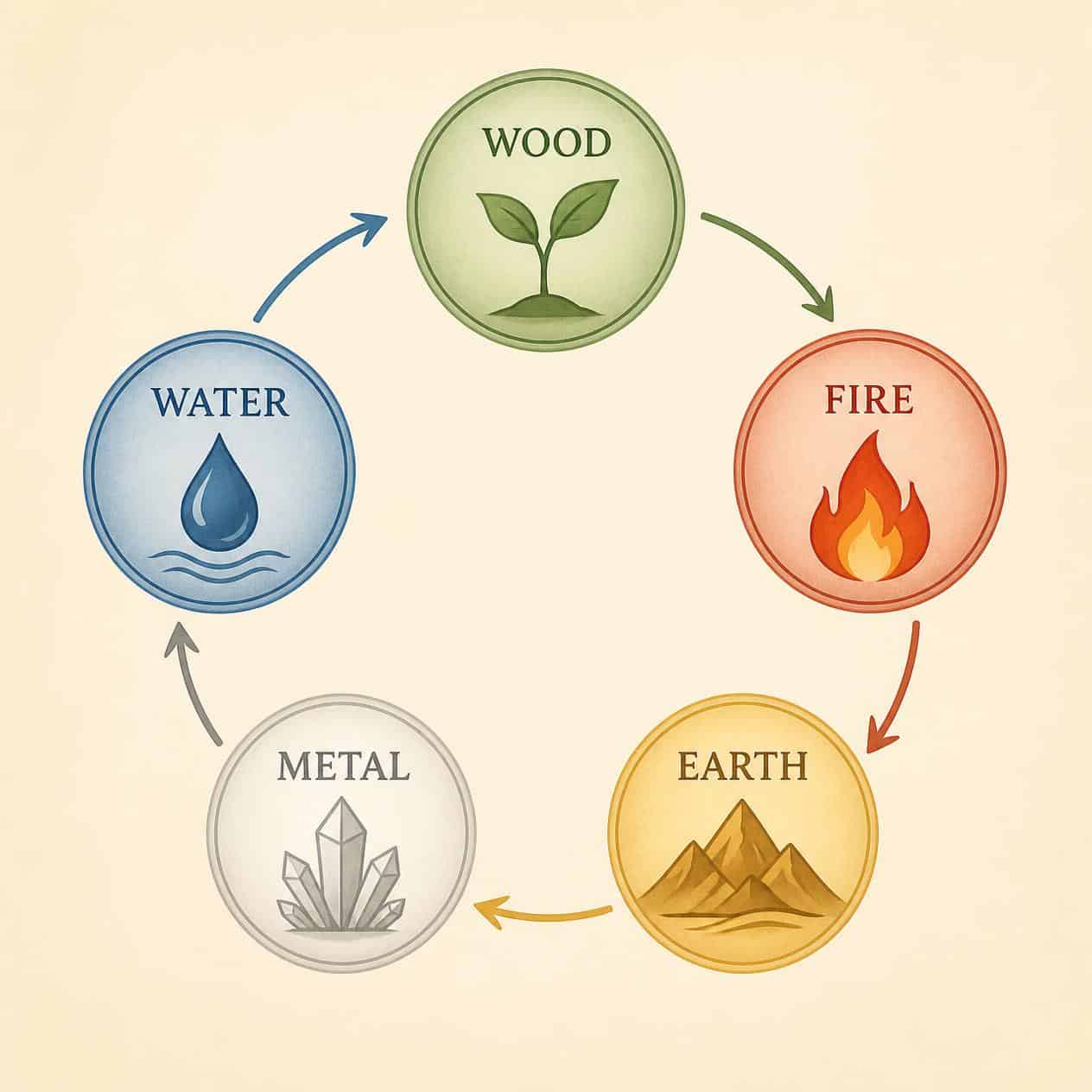
The Five Elements are Wood, Fire, Earth, Metal, and Water. They are not literal substances. Instead, they are five ways energy moves in nature:
- Wood — energy expanding outward (like a sprout breaking through soil)
- Fire — energy rising upward (like a flame)
- Earth — energy centering and holding (like the ground beneath us)
- Metal — energy drawing inward (like autumn leaves falling)
- Water — energy storing and sinking (like a river resting in winter)
In this view, nature is not random. It moves in cycles — and so do we.
The Five Elements and the Seasons
Each element is linked to a season. This is why, in Chinese tradition, eating and living habits shift with the calendar:
| Element | Season | Direction of Energy | Simple Meaning |
|---|---|---|---|
| Wood (木) | Spring | Expanding outward | Growth, new beginnings |
| Fire (火) | Summer | Rising upward | Vitality, brightness, warmth |
| Earth (土) | Late Summer | Centering | Nourishment, grounding |
| Metal (金) | Autumn | Contracting inward | Harvest, letting go |
| Water (水) | Winter | Storing downward | Rest, deep renewal |
Note: “Late Summer” is the brief transition period between summer and autumn, sometimes called “Indian Summer” in the West.
The Five Elements and Your Body
Traditional Chinese medicine links each element to specific organs and emotions. This is a map, not a prescription — it is one way of understanding how the body works as a whole.
| Element | Organs | Emotion | Traditional Color | Everyday Analogy |
|---|---|---|---|---|
| Wood | Liver, Gallbladder | Anger | Green | Like a tree: needs room to grow freely |
| Fire | Heart, Small Intestine | Joy | Red | Like a flame: bright, warm, alive |
| Earth | Spleen, Stomach | Worry | Yellow | Like soil: digests and nourishes |
| Metal | Lungs, Large Intestine | Grief | White | Like autumn: clear, precise, letting go |
| Water | Kidneys, Bladder | Fear | Black / Dark blue | Like a well: stores deep reserves |
The traditional idea behind this map: each organ is not just a physical pump or filter — it also carries a “quality of energy” that connects to your emotions and your environment.
Everyday Wisdom: “Cover Up in Spring, Hold Back in Autumn”
In China, nearly everyone has heard the saying “春捂秋冻” — roughly, “cover up in spring, hold back in autumn.” It is a simple example of Five Elements thinking applied to daily life.
- Spring (Wood): energy is expanding outward. Keeping slightly warmer helps the body open up gradually, instead of being shocked by lingering cold winds.
- Autumn (Metal): energy is drawing inward. Being a little cool helps the body adjust and prepare for winter’s deep rest.
You do not need to memorize theory to benefit from it. The idea is simple: move with the seasons instead of against them.
How the Elements Work Together: Generation and Control
The Five Elements are not isolated. They interact in two main cycles:
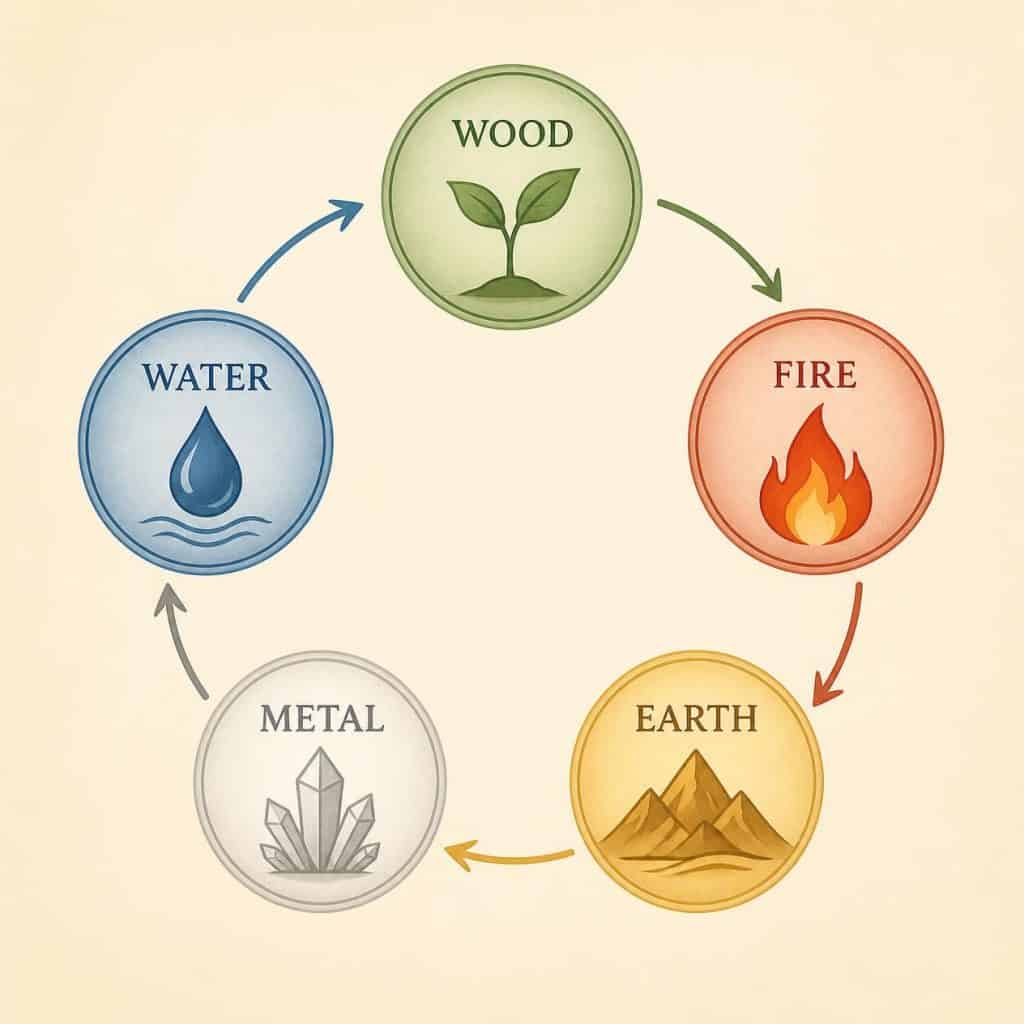
The Generating Cycle (相生): each element nourishes the next —
Wood → Fire → Earth → Metal → Water → Wood
(Wood feeds Fire, Fire creates ash/Earth, Earth bears Metal, Metal condenses Water, Water nourishes Wood.)
The Controlling Cycle (相克): each element keeps another in check —
Wood → Earth → Water → Fire → Metal → Wood
(Wood holds back Earth, Earth dams Water, Water cools Fire, Fire melts Metal, Metal cuts Wood.)
Together, these two cycles describe a dynamic balance — a system that is alive because it moves, checks, and adjusts itself.
One Simple Step You Can Take This Week
You do not need to learn everything at once. A gentle starting point:
Eat with the season. This week, choose one fruit or vegetable that is naturally in season where you live, and make it part of one meal. That is a small, practical step grounded in Five Elements thinking.
Over time, you can explore more: how flavors (sour, bitter, sweet, pungent, salty) relate to the elements, or how each season suggests a different rhythm of rest and activity.
Final Thoughts
The Five Elements are not a mystical secret. They are an observation model — a way ancient Chinese thinkers organized what they saw in nature and in the human body.
Whether or not you follow every traditional detail, the underlying message is worth keeping: life is about balance, rhythm, and connection — with the seasons, with your body, and with the people around you.
Disclaimer: This article is for educational and informational purposes only. It is not medical advice and is not intended to diagnose, treat, cure, or prevent any disease. Always consult a qualified healthcare professional before making changes to your diet, lifestyle, or health routine. Traditional Chinese medicine views are presented as cultural and historical perspectives.